Future Ecommerce Trends: 10 Possible Forecasts for 2023
The eCommerce business is on the rise and will evolve remarkably in the near future. It changes customer behavior, needs, and shopping trends a lot. Within 25 years this industry has made over 2 trillion US dollars in sales worldwide.
Adaptation of new technology, large customization, policy evolution, and smart integration with advanced solutions have taken the eCommerce industry by storm.
1. Global Retail eCommerce Sales will Increase Worldwide
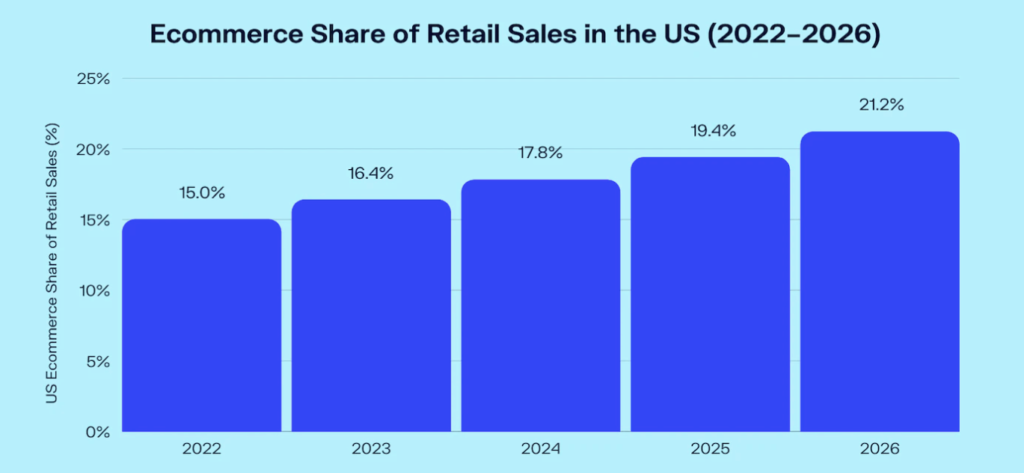
eCommerce sales have been rising continuously worldwide. It has revolutionized the retail business in the last 25 years. According to Statista, the sales are projected to increase from $1.3 trillion in 2014 to $4.5 trillion in 2021. It has evolved a lot with the advancement of technology and the changing demand of customers.
Now the users often use their portable devices to check the products before finalizing the orders. It makes mobile optimization a necessity for online retailers.
So, eCommerce companies must optimize their sites for mobile users if they want to grow the business fast.
3. B2B eCommerce Will Continue to Outperform B2C eCommerce
The new trend of eCommerce has become a game-changer for both B2B and B2C companies. It is being conceived that B2B eCommerce is outpacing B2C, and will soon outperform it. B2B eCommerce entails wholesale distributors selling goods to peer entrepreneurs.
Moreover, B2B minimizes the hassle of manual processes using an online sales portal. It lets businesses sell and distribute the products from one business to another through online channels. It will, however, increase your sales with a stronger online presence at a lower cost.
4. Omnichannel Retail in eCommerce
Omnichannel retail is a modern sales approach that ensures a unified shopping experience for customers. Multi-channel eCommerce business refers to promote and sell products on multiple channels including E-Commerce websites, marketplaces, and even offline.
Interestingly, it will blur the distinctions among channels, both physical and online. Customers will have more chances to get information about your products or services. Furthermore, when you will promote your brand in different channels that may increase sales opportunities and brand recognition.
However, customers can visit multiple channels during their shopping process. It lets a user start his/her journey at one channel and complete the purchase at another one. That’s why the Omnichannel retail approach has been adopted by different marketing strategies to boost their eCommerce business.
5. Voice Shopping to Take Center Stage
Voice shopping is gradually becoming mainstream for next-generation online buyers. Researchers say more than 50% of US population uses voice search features daily, and more than one-third (34%) uses them at least once a week.
Big shots like Amazon, Alibaba, Walmart, and other giant companies have already introduced voice shopping in their online grocery. This eCommerce trend starts getting popular in 2014 when Amazon launched its smart speaker – Echo.
6. Social Media Enters Online Shopping
Social media is not only a channel anymore which connects people together. Besides promoting products or services, social media platforms let retailers sell their products directly. Now, social shoppers can purchase products through Buy Button on Facebook or Instagram Checkout.
For many people, the social platform is the first point of contact with any business. Nowadays buyers prefer to read reviews from real users. They follow the brands and are more likely to buy products from the ones they follow.
However, eCommerce owners can get help from Facebook and Instagram influencer to promote their brand widely. Social media exposure will continuously influence your audience to connect with your brand.
Thus, Social Media becomes a noteworthy marketing tool to increase loyal advisors with optimal sales for your business. The number of social media users and social influencers is increasing broadly. Therefore, online retailers should come with better social marketing strategies to explore more opportunities for their stores.
7. Increased AI Use in eCommerce
eCommerce or digital shop has taken the business prospect to the next level with the help of artificial intelligence. By integrating AI technology into your business you can analyze the store data and buyer’s behavior more efficiently.
AI solutions allows brands to better understand their customers and ensure personalized service and marketing. It’s projected that, AI-powered eCommerce solutions will be worth $16.8 billion by 2030.
Moreover, AI has empowered customers with many high-tech experiences. Such as visual search, personalized recommendation, voice assistant, and so forth. On the other hand, an online seller can improve the pricing module and product representation with the help of AI.
In fact, a recent study by Business Insider suggests that more than 85% of customer interactions will be managed by chatbots in future.
8. Headless eCommerce in Game
Headless eCommerce is in growing popularity among shop owners as it makes tasks easier. It uses two different technology the front end and the back end. The regular front end maximizes the utilization of content while the eCommerce back end can effectively run your business activity.
Headless eCommerce de-couples the front end and backend of your eCommerce platform. Suppose a customer clicks on Buy Now, and immediately the store gets a call to retrieve information from the backend. This is the general process of a traditional eCommerce. headless eCommerce will make the transaction faster using API to retrieve the information.
Online merchants have a good number of advantages for using Headless eCommerce. Such as:
– Modern technology to create faster and catchy website
– Familiar to the web developer
– Ownership of site structure
– Apply successful marketing campaign without harming the backend eCommerce operation
– Less cost for customer acquisition and retention
– Higher conversion rate compared to traditional websites and eCommerce platform
Again, it is compatible to open source applications that enhance expandability.
9. Augmented Reality to Visualize Purchases
Online shopping makes modern life easier by bringing everything to your door. Without wasting time in traffic or waiting in the queue now you can make the purchase within a few clicks only. Not only that you get the flexibility to browse a lot of products and compare their price & quality in a faster way. Quick delivery makes the eCommerce shopping experience higher than ever.
Besides so many benefits there is a major downfall in online shopping. You can’t see the product in detail every time. Sometimes consumers predict wrong about the product and end up with high dissatisfaction. However, Virtual and Augmented reality can bridge this gap. It provides you with a 360- degree view of any product or place. Therefore you can easily realize how it will serve your purpose in real life.
This means VR gives consumers a virtual tour of how a product actually looks in reality. And AR explains more details to understand whether it meets their needs or not.
10. Increase Popularity in Subscription Models
Digital customers prefer a subscription-based business model to a one-time payment. It makes them confident about their spendings. Also, eCommerce owners find it an easier way to onboard new users and make them come to the shop again and again.
This eCommerce model is getting popular over the past years. By understanding how it works and set up a realistic pricing strategy you can build the foundation for your online business. You can charge customers with recurring fees monthly or yearly basis to access a product or service. Hence, customers need not pay a large amount at once. Rather they can use the product for a particular time period. And have the freedom to decide either to extend the subscription or not once it expires.